How many Bibles do you own? Perhaps you have one beside your bed, another on a bookshelf and a Bible app on your phone. Today we can open the Bible whenever we choose, read it in our own language and even listen to it being read aloud.
It is easy to take that freedom for granted. There was once a time when ordinary people in England could not simply pick up an English Bible and read God’s Word for themselves.
William Tyndale was willing to sacrifice his home, his freedom and ultimately his life because he passionately believed that everyone should be able to read the Word of God.
A Man Who Loved God’s Word
William Tyndale was born in England around 1494 and became a gifted scholar, studying at Oxford and later spending time at Cambridge. As he studied Scripture, Tyndale became convinced of the message at the heart of the Gospel: that salvation was not something we could earn through religious works, but that we are justified before God through faith in Jesus Christ.
For Tyndale, the Bible was not simply an old religious book reserved for priests and scholars. It contained the truth about Jesus Christ and eternal life, and he desperately wanted ordinary people to be able to discover that truth for themselves.
At the time, the Bible used officially in the English church was in Latin, a language most ordinary people could not understand. Producing or possessing unauthorised English translations could also bring severe punishment.
Tyndale became determined to change this. He wanted to translate Scripture from Greek and Hebrew into clear English so that everyone could understand it.
Even a Ploughboy Should Know the Bible
During one famous argument, a clergyman reportedly suggested that people would be better without God’s laws than without the Pope’s. Tyndale gave a fearless response:
“I defy the Pope and all his laws… If God spare my life ere many years, I will cause a boy that driveth the plough to know more of the Scripture than thou dost.”
That became the great mission of his life. Tyndale believed God’s Word should not belong only to educated scholars or church leaders. The farmer working in his field, the mother caring for her children and even the young boy driving a plough should be able to read Scripture and understand what God had said.
Tyndale initially hoped to carry out his translation work legally in England, but he was unable to gain the support he needed. Eventually, he realised that to continue his mission he would have to leave his homeland.
Forced to Flee England
Around 1524, Tyndale left England and travelled to continental Europe. He would never return home.
Despite the danger, he began translating the New Testament directly from Greek into English. His English New Testament was printed in 1526, and copies began making their way secretly into England.
Authorities attempted to stop them. Copies were confiscated and publicly burned, but the Bible continued to spread. For the first time, increasing numbers of ordinary English men and women were able to read the words of Scripture for themselves.
Tyndale continued working while moving around Europe and trying to avoid capture. He revised his New Testament and began translating large parts of the Old Testament from Hebrew.
His influence on the English language was enormous. Familiar biblical expressions including “the salt of the earth,” “the powers that be,” “my brother’s keeper” and “fight the good fight” are associated with Tyndale’s translation.
But while his words were spreading throughout England, Tyndale himself was being hunted.
Betrayed and Imprisoned
Eventually, Tyndale was betrayed by a man named Henry Phillips, who had gained his trust. In 1535, Tyndale was captured near Antwerp and imprisoned at Vilvoorde Castle.
He would spend more than a year in prison under terrible conditions. One surviving letter from this period gives us a remarkable insight into the man Tyndale was.
He asked for warmer clothing and a lamp to help him through the cold, dark winter nights. But he also asked for something else: his Hebrew Bible, Hebrew grammar and Hebrew dictionary.
Even imprisoned and facing the possibility of death, Tyndale still wanted to study God’s Word and continue the work to which he had devoted his life.
William Tyndale’s Final Prayer
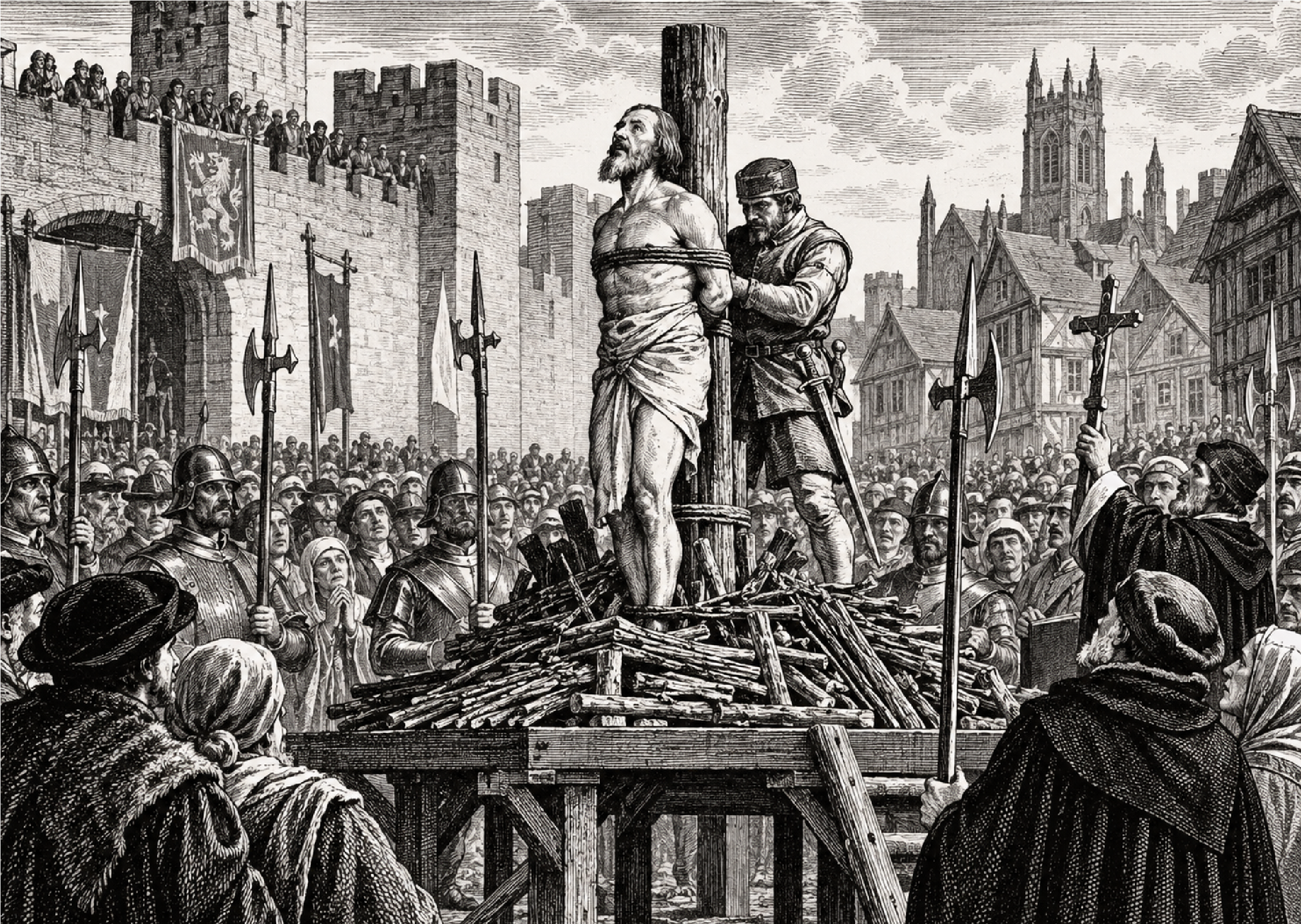
In 1536, William Tyndale was condemned as a heretic. He refused to abandon his convictions and on 6th October 1536 he was taken from the castle to be executed.
Tyndale was strangled and his body was then burned. He was only around 42 years old.
According to the traditional account, just before his death Tyndale cried out one final prayer:
“Lord, open the King of England’s eyes.”
Tyndale died without knowing just how quickly that prayer would appear to be answered.
The Bible Comes to England
The work Tyndale had been killed for could not be killed with him. England was already beginning to change, and English translations of the Bible increasingly became accepted.
In 1535, Miles Coverdale produced the first complete printed English Bible, drawing heavily upon Tyndale’s work. In 1537, the Matthew Bible, which also incorporated much of Tyndale’s translation, received royal approval.
Then, in 1538, only two years after Tyndale’s death, an order required an English Bible to be placed in every parish church.
Think about that for a moment. Tyndale had been hunted, imprisoned and killed for helping to translate the Bible into English, yet within a few years English Bibles were being placed inside churches for people to read.
His influence continued long after his death. When the King James Bible appeared in 1611, its translators inherited a huge amount from the English Bible tradition Tyndale had helped establish. Much of the familiar language generations of Christians would come to know had its roots in his work.
Do We Take Our Bibles for Granted?
William Tyndale’s testimony leaves Christians today with an important question: how much do we value the Bible we now have so freely?
Tyndale left his country for it. He lived as a wanted man for it. His translations were confiscated and burned because of it. He continued studying it from a prison cell, and eventually he gave his life for the work of making it available to others.
Yet today many of us own several Bibles and barely open them. We can carry one openly, order one online, download one to our phones and read Scripture whenever we want.
Nobody is stopping us, yet sometimes we simply don’t make the time.
Psalm 119:24 says: “Your testimonies are my delight and my counsellors.”
Tyndale understood just how precious God’s Word was. He believed that ordinary people needed to hear the truth of Scripture and know Jesus Christ for themselves.
Nearly 500 years later, we are still benefiting from his courage and determination. So the next time you pick up your Bible, remember William Tyndale. Remember the man who left his home so others could read it, the translator who continued while being hunted, and the prisoner who asked for his Hebrew Bible so that he could carry on studying.
Most of all, remember the man whose final prayer was that England’s eyes would be opened.
William Tyndale gave his life helping ordinary people read the Word of God. May we never take for granted what he sacrificed so much to give us.
Watch William Tyndale’s Story
To discover more about William Tyndale and the extraordinary story of his faith, courage and sacrifice, you can watch the full movie about his life below.
Leave a Reply