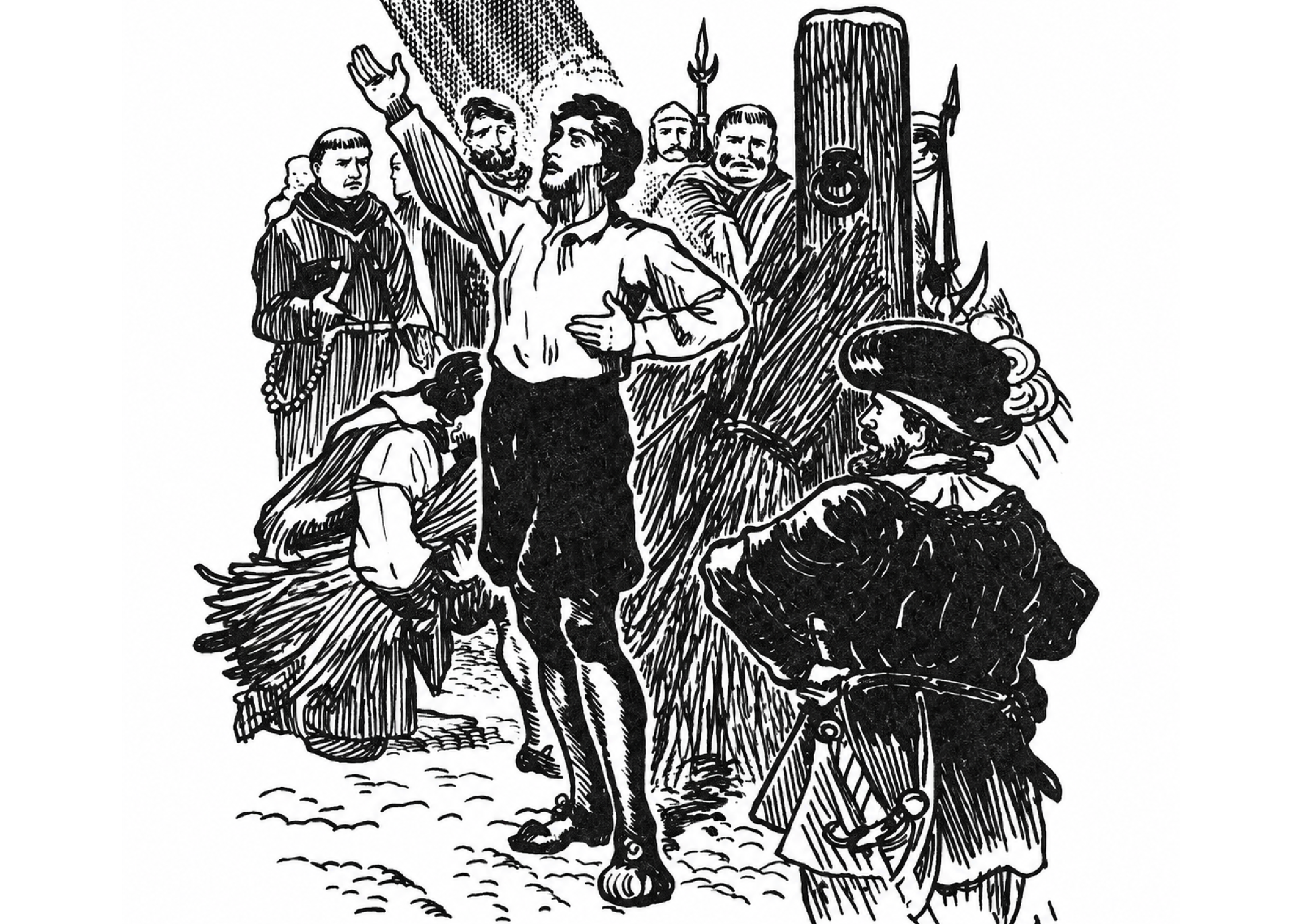
On the morning of 26th March 1555, the town of Brentwood was filled with people. Crowds gathered in the streets alongside priests, friars, church officials and soldiers carrying weapons. They had all come to witness the execution of a young man named William Hunter.
What terrible crime had he committed? William had been caught reading the Bible and refused to turn away from what he believed to be the truth of God’s Word. For this, he would be burned at the stake. He was only 19 years old.
It Started With Reading the Bible
William Hunter lived during the reign of Queen Mary I, when England was an extremely dangerous place for those who openly rejected Roman Catholic teaching. Protestants who refused to change their beliefs could face imprisonment and execution for heresy.
William’s troubles began when he was found reading a Bible in a chapel. A servant of the Bishop named Atwell confronted him and angrily asked why he was meddling with the Bible. William gave a simple reply. He “read it to his comfort.”
Atwell warned him, “If you do not turn, you and many other heretics will broil for your opinions.” William knew he was now in danger and, worried that his parents and family might also suffer because of him, he fled Brentwood.
After being away for a short time, William returned home. He was quickly arrested and thrown into prison.
“I Cannot Turn From God”
William was brought before Edmund Bonner, the Bishop of London, who tried to persuade him to change his beliefs. According to the account of William’s life, the Bishop even offered him money and a position within his household if he would recant.
For a teenager facing the possibility of death, it was an opportunity to save himself. But William refused.
He reportedly told the Bishop:
“My Lord, if you cannot persuade my conscience by Scripture, I cannot turn from God for the love of the world, for I count all things but loss in comparison with the love of Christ.”
William could have chosen the easier path, but he would not say something he did not believe simply to save his own life.
“We Shall Meet Again”
After his trial, William was taken back to Brentwood. As there was no prison in the town, he was guarded by constables at the Swan Inn. His mother was able to visit him there and, despite knowing what was about to happen, William tried to comfort her.
“For a little pain I shall receive a crown of life, and may you not be glad for that?” he told her.
His mother replied that she thanked God that her son had remained such a champion for Christ.
On the morning of William’s execution, his father broke through the crowd and cried, “God be with thee, son William.”
William answered:
“Be of good comfort, father, we shall meet again where we shall rejoice together.”
For a father and mother facing the death of their 19-year-old son, these must have been incredibly difficult words. Yet William believed death would not be the end and that they would meet again.
One Last Chance to Save His Life
William was taken to the stake and chained in place. Even at this final moment, he was offered a pardon if he would recant his beliefs.
Once again, he refused.
William had been threatened, imprisoned and offered money and freedom. Now, with death directly in front of him, he was given one final opportunity to save his life. He still would not deny his faith.
The fire was lit and the flames began to rise around him. William reportedly cried out:
“I am not afraid, Lord! Lord! Receive my spirit.”
“Son of God, Shine Upon Me”
As the fire burned around him, William prayed:
“Son of God, shine upon me.”
According to the traditional account, the sky had been dark and cloudy, but immediately after William prayed, the sun broke through the clouds and shone upon his face. Those watching believed it was an outward sign that his prayer had been heard in Heaven.
Soon his head bowed in the smoke. On 26th March 1555, William Hunter died at only 19 years old.
Why Would a 19-Year-Old Choose Death?
It can be difficult today to imagine why somebody so young would refuse a pardon that could have saved him. William had his entire life ahead of him. All he needed to do was say what his captors wanted to hear and abandon the beliefs that had brought him there.
But William believed his relationship with Jesus Christ was worth more than his earthly life. The Bible he had once been found quietly reading for comfort contained promises he was now prepared to die believing.
His age makes his testimony even more remarkable. William wasn’t an elderly preacher or theologian approaching the end of a long life. He was a teenager who could have had decades ahead of him.
Yet when asked to choose between saving his life and denying his faith, William chose Christ.
He Was Not the Only One
William Hunter was one of many Christians executed for their Protestant faith during the reign of Queen Mary I. Memorials to martyrs from this period can still be found across England today.
The original account of William’s story mentions martyrs at Beccles, Norwich, Bury St Edmunds, Ipswich, Colchester, Chelmsford and Laxfield in Suffolk.
William Tyndale had suffered a similar fate years earlier after dedicating his life to translating the Bible into English so ordinary people could read God’s Word for themselves.
These Christians lived at a time when their beliefs could cost them everything. They could lose their homes, their freedom and ultimately their lives, yet many still refused to deny Jesus Christ.
The Boy Martyr Who Is Still Remembered
Nearly 500 years later, William Hunter is remembered as the Boy Martyr of Brentwood. What makes his testimony so powerful is not simply the terrible way in which he died, but the faith he showed when he was repeatedly offered a way out.
Before his death, William had comforted his mother by telling her that after a little pain he would receive “a crown of life.”
Revelation 2:10 says:
“Be thou faithful unto death, and I will give thee a crown of life.”
William Hunter was only 19 years old when he gave his life for what he believed. He could have saved himself by denying his faith, but he chose to remain faithful to Jesus Christ until the end.
An Invitation
Jesus is the only Saviour. No religion can save you. This is not about religion; it is about life. Jesus said, “Except a man be born again, he cannot see the Kingdom of God.” (John 3:3) Being born again means confessing your sins to Jesus, accepting Him as your Saviour, and receiving a new life.
Jesus offers you forgiveness and eternal life. Will you accept Him today? He loves you and is waiting for you.
Do you know where you are going?
All who want to go to heaven must be born again. Jesus talked about heaven, and He said, “In my Father’s house are many mansions.” Also, He said, “I am the way, the truth, and the life; no man comes to the Father but by me.” (John ch. 14 v. 2, 6)
The Lord Jesus Christ is the only Savior there is
If Jesus is right (and He most certainly is), then all other ways are wrong! Religions are a waste of time; they cannot save you. Only Jesus can. God did not create the religions of the world; man did, to satisfy his conscience! “Man is learning and never able to come to the knowledge of the truth.” (2 Timothy ch. 3 v. 7) This is not religion; it is life!
Do you know the one who died on the cross for you?
When Jesus came, He told us something that no religion has ever thought of and which contradicts the basic principle of all religions. He said, “Except a man be born again, he cannot see the Kingdom of God.” (John ch. 3 v. 3). Jesus said that He is the only way to God the Father, and the new birth is the only way to heaven. What did He mean? He meant a spiritual birth whereby a person is able to confess his sins to Jesus Christ, accept Him as Savior, and receive a new life. This is the Gospel. Look and live. Out of religion, and into Christ!
Salvation Prayer
“Lord Jesus Christ, I believe that You died for me. I acknowledge that I am a sinner. Please come into my life and forgive my sins. And save me. Amen.”
Leave a Reply